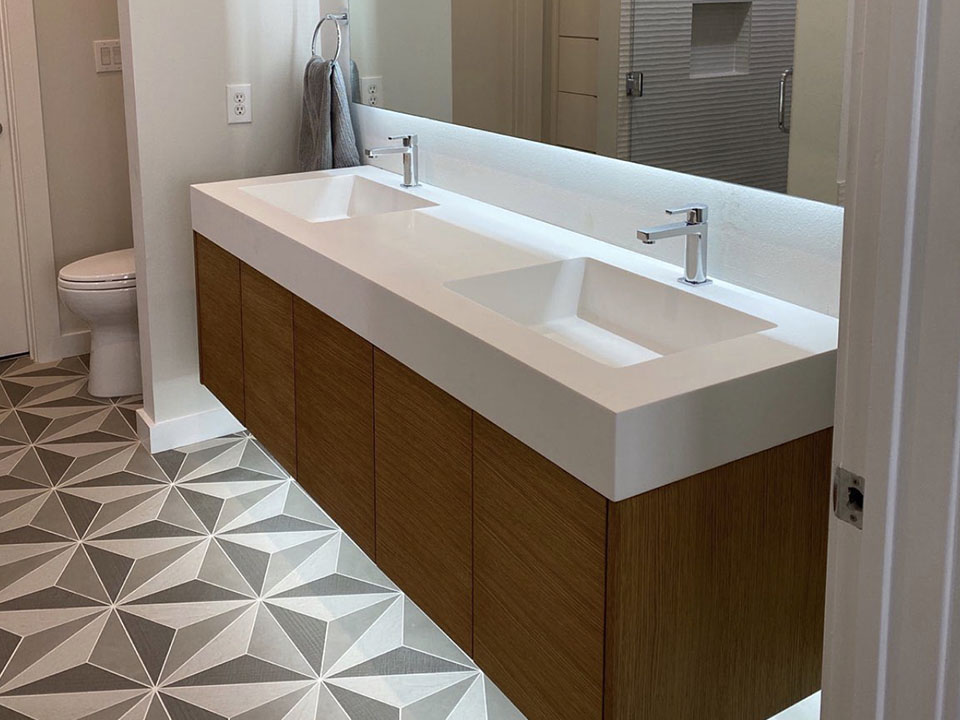
For more than 20 years, SPW Surfaces has operated with a typical lead time of approximately 7 to 10 business days from completed template and material availability to installation.
That timeframe has remained remarkably consistent because we have built our fabrication process around repeatable systems, careful scheduling and completing as much work as possible in our shop before installation.
In recent years, however, construction schedules have become increasingly unpredictable.
Projects are often delayed long before they reach the countertop phase because of framing, foundation, mechanical work, cabinetry, appliances, inspections, material shortages, and other trades. By the time the cabinets are finally ready, the countertop schedule may already be several weeks behind.
We understand the pressure that creates.
We also regularly receive calls from customers and contractors asking whether we can template a project on Monday and install it by Friday.
While it is rare that we can accomodate this, sometimes we can.
But there are a few things that are important to understand about how SPW Surfaces schedules and fabricates solid surface countertops.
Our Standard Lead Time
Our normal production schedule is approximately:
7 to 10 business days after templating
This assumes:
- The project is ready to template
- Final selections have been made
- We have received the required deposit
- The selected material is available
- There are no unusual fabrication requirements or changes to the project
Lead times can vary based on project size, material availability, complexity, holidays and current production volume.
We will always give you the most accurate scheduling information we can at the time your project is released.
Material Availability Matters
One of the biggest changes in recent years has been securing materials.
Many solid surface materials that were once stocked locally are now stored in regional warehouses outside Texas. Depending on the manufacturer and color selected, materials may need to ship from states such as Tennessee, California or other distribution centers.
That means it can sometimes take several business days, or occasionally longer, just to get the material into our shop.
For that reason, if your project has a critical schedule, one of the best things you can do is release the project and provide your deposit as early as possible.
Once we have the required deposit, we can order the material and have it in our possession before the project is ready to template whenever scheduling allows.
That can eliminate one of the biggest potential delays later in the process.
If Your Project Is Behind Schedule
We understand that delays are a significant source of stress on construction projects.
Cabinets may have arrived late. Mechanical work may have taken longer than expected. Another trade may have pushed the schedule back. A closing date, inspection, opening date or move-in may now be approaching quickly.
If you are in that situation, call us as early as possible.
Depending on the size and complexity of the project, material availability and our existing production schedule, we may be able to accommodate a faster turnaround.
We have completed projects in less than one week when the circumstances allowed.
However, expedited scheduling is not always possible.
Our production schedule is typically committed 7 to 10 business days in advance. Accommodating a rush project can require us to reorganize shop production, move fabrication assignments, reschedule installers, arrange faster material delivery or otherwise adjust previously scheduled work.
Because of that, expedited fabrication and installation may include additional rush fees.
Those fees are based on the amount of schedule adjustment required and the size and complexity of the project.
What We Will Not Do to Save a Few Days
We will do everything reasonably possible to help a project recover lost time.
What we will not do is eliminate or skip our standard practices and proceedures that allow us to produce the quality of work our customers expect.
There are several steps in our process that are not optional.
We Require a Template
SPW does not fabricate finished countertops from rough cabinet dimensions with the expectation that the installers will simply make everything fit onsite.
Homes and commercial spaces are rarely perfectly square.
Walls bow. Cabinets vary slightly. Corners are not always 90 degrees. Overhangs, appliance openings, finished ends, backsplashes, sinks and surrounding conditions all affect the final countertop dimensions.
Templating allows us to document those actual conditions before fabrication begins.
That lets our fabricators complete the majority of the cutting, fitting, seaming, edge work, reinforcement and finishing in a controlled shop environment.
The result is better fit, better finish, less disruption in the home and a more predictable installation.
Skipping the template may appear to save time initially.
In our experience, it usually does the opposite.
It moves fabrication into the field, creates additional fitting and sanding onsite, increases dust and disruption, introduces unnecessary variables and can produce a finished result that does not meet our standards.
After more than 20 years of fabricating solid surface, we know that templating is part of producing a professional countertop, not an unnecessary step in the schedule.
We Require a Deposit Before Ordering Material
SPW also does not order project-specific material until the required deposit has been received.
Solid surface is available in hundreds of colors from multiple manufacturers, and many sheets are ordered specifically for an individual project.
The deposit allows us to release the material order, reserve production capacity and begin preparing the project for fabrication.
If schedule is important, getting the deposit to us early is one of the most effective ways to keep the countertop portion of the project moving.
Faster Is Not Always Faster
When a project is behind schedule, there is an understandable temptation to eliminate steps.
Skip the template.
Fabricate from rough measurements.
Make the installers fit everything onsite.
Order the material later.
Move straight into production.
On paper, those shortcuts can make the schedule look faster.
In practice, they often create more field labor, more fitting, more dust, more corrections, more trips to the jobsite and a less predictable installation.
Our process exists because we have spent decades learning which methods consistently produce the best result.
The objective is not simply to get countertops onto cabinets as quickly as possible.
The objective is to get them measured correctly, fabricated correctly, installed correctly and completed with as little disruption to the customer as possible.
How to Get the Fastest Possible Turnaround
If your project has an aggressive schedule, the best approach is to involve SPW early.
Whenever possible:
- Finalize your solid surface selections early.
- Let us know immediately if the project has a critical completion date.
- Submit your deposit so material can be ordered.
- Make sure cabinets are completely installed and ready for templating.
- Have sinks, cooktops, faucets and appliance specifications available before template.
- Avoid making design changes after templating.
- Tell us about schedule changes as soon as you become aware of them.
The earlier we know the constraints, the more options we usually have.
Quality Still Comes First
SPW Surfaces has spent more than 20 years developing systems and processes specifically for solid surface fabrication and installation.
Those systems are the reason we can maintain reliable lead times while still producing the level of craftsmanship our customers expect.
We understand that construction schedules change.
We understand that projects get behind.
And when we have the ability to help recover some of that lost time, we will.
But we will not solve a scheduling problem by creating a quality problem.
Our goal is always the same:
Complete your countertops as efficiently as possible while delivering the quality of fabrication, installation and customer experience that SPW Surfaces has built its reputation on.
If you have a project with a critical schedule, contact us as early as possible. We will review the project, material availability and our current production schedule and tell you realistically what we can accomplish.
Your Project Must Be Template-Ready
The template is the point at which SPW captures the final dimensions of your countertop project.
Because we fabricate from those dimensions, the cabinetry and surrounding conditions must be complete and final before we arrive.
At the time of template:
- All cabinets must be completely installed and permanently secured in their final locations.
- All cabinet fillers, panels, finished ends and other components that affect the countertop dimensions must be installed.
- No cabinet changes can be made after templating.
- The sink must be onsite. For undermount and integrated sink applications, we will typically take the sink back to our shop so it can be mounted or incorporated into the countertop during fabrication.
- The cooktop must be onsite if SPW is cutting the cooktop opening. Having the actual appliance available allows us to verify the opening requirements rather than relying solely on published dimensions.
Once the project has been templated, the cabinets cannot be moved, adjusted, replaced, shimmed into a different position or otherwise modified in a way that changes the countertop dimensions.
Even a small cabinet change can affect wall fit, seam locations, overhangs, appliance openings, backsplashes and finished ends.
If cabinetry is not complete when we arrive, the project may need to be rescheduled for templating once the space is ready. There may or may not be a trip charge for having to make a second trip.
What About Faucets?
Your faucet does not need to be onsite at the time of template.
SPW Surfaces typically drills faucet and accessory holes during installation.
However, the faucet, soap dispenser, filtered-water faucet, air switch, or any other fixture requiring a hole in the countertop must be onsite at the time of installation.
This allows our installers to verify the actual fixture dimensions and determine the correct spacing before drilling.
We do not recommend drilling faucet holes based solely on assumptions or rough dimensions when the actual fixture can be verified onsite.
Why We Require This
These requirements are not intended to complicate the construction schedule.
They exist because templating only works when we are measuring the final conditions.
If cabinets are changed after the template, or if critical appliances and sinks are unavailable when dimensions are being confirmed, the countertop may no longer fit the space as intended.
Our goal is to measure once, fabricate accurately and arrive at the installation with countertops that fit the project correctly.
That saves time overall, reduces unnecessary field fabrication and produces a better finished result.