What to Expect When Purchasing Solid Surface Countertops
Purchasing solid surface countertops is a different process from buying quartz, granite or other slab materials. Solid surface materials are acrylic or polyester based materials that can be cut, bonded, shaped, sanded, repaired and finished to create countertops that are exceptionally clean, durable and tailored to the space.
At SPW Surfaces, solid surface is not one of many materials we work with. It is the only material we work with.
For more than 20 years, we have developed and refined our templating, fabrication and installation processes specifically for materials such as Corian®, HI-MACS®, Staron®, Wilsonart® Solid Surface, LivingStone®, Durasein®, Meganite® and other premium solid surface brands. Our goal is to make the process predictable for the customer while producing the highest-quality finished installation possible.
1. Selecting Your Solid Surface Material
The process begins with choosing the right material, color, pattern and finish for your project.
Solid surface is available in hundreds of designs ranging from clean solid colors and subtle particulate patterns to modern concrete looks and sophisticated veined designs. Solid surface manufacturers offer different price points, patterns and colors.
We can help you evaluate the options based on the way the space will be used, the desired appearance, budget, edge details, sink configuration and other design considerations.
Unlike natural stone, solid surface is nonporous and does not require periodic sealing. It can also be renewed and repaired if it becomes scratched or damaged over time, making it particularly well suited for kitchens, bathrooms, healthcare environments, commercial spaces and other demanding applications.
2. Field Measurement and Templating
Once the cabinetry and surrounding conditions are ready, we will field-measure and template the project.
Templating is one of the most important stages of a successful solid surface installation. We document the actual conditions of the space, including cabinet dimensions, wall conditions, finished end locations, appliance openings, sink placement, overhangs, backsplashes and other critical details.
Walls and cabinets are rarely perfectly straight, square or level. Our job is to identify those conditions before fabrication begins and account for them appropriately.
Accurate templating allows us to fabricate as much of the countertop as possible in our controlled shop environment rather than making unnecessary modifications inside your home.
For most projects, cabinets, sinks, faucets, appliances, and other items affecting the countertop layout should be finalized before templating.
3. Shop Fabrication
After templating, your countertops are fabricated in our shop specifically for your project.
Solid surface fabrication requires considerably more than simply cutting a slab to size. Depending on the design, the process may include cutting and machining the material, laminating countertop edges, fabricating backsplashes, creating sink or cooktop openings, thermoforming components, assembling sections, reinforcing critical areas, bonding seams, shaping edge profiles and sanding the finished surfaces.
One of the primary advantages of solid surface is the ability to chemically bond pieces together and finish those joints so they become inconspicuous. When the material, color, layout and site conditions allow, seams can often be dramatically less noticeable than those found in most natural stone, quartz or porcelain countertops.
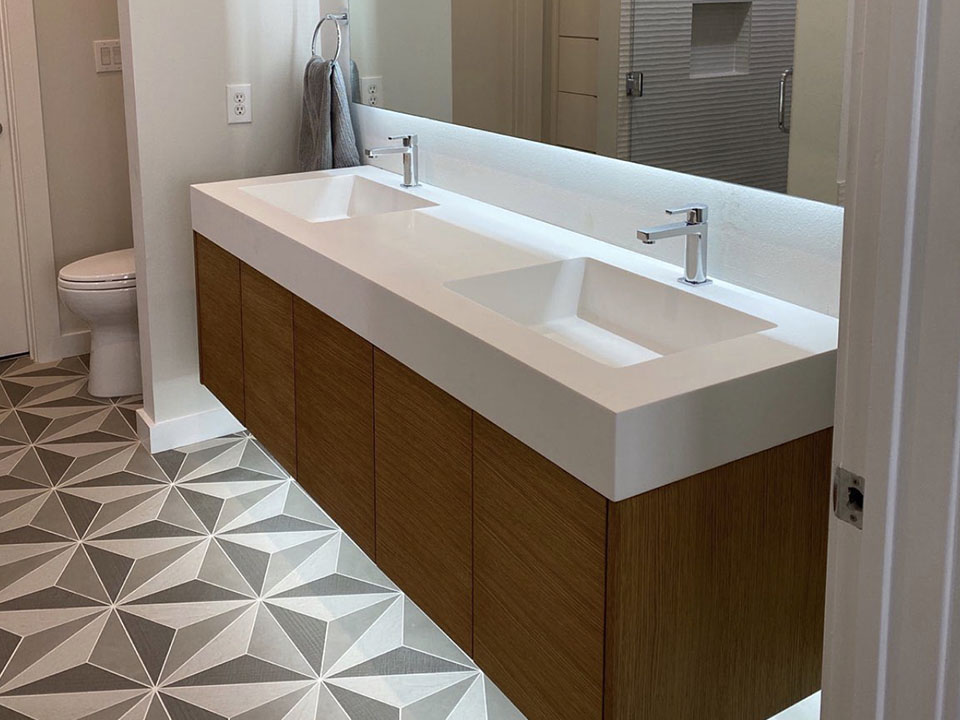
Integrated solid surface sinks can also be bonded directly into the countertop, creating a smooth transition without the exposed rim or silicone joint commonly found around other sink installations.
Whenever practical, we complete fabrication in our shop where we can maintain better control over tooling, dust collection, lighting, temperature, finishing and quality inspection.
4. Installation
On installation day, our team will bring the fabricated countertop sections into the space, carefully fit them to the cabinetry and surrounding walls, complete any required field seams, secure the countertops properly and perform the final finishing work.
Some field fitting is normal. Homes are rarely perfectly square, and small adjustments may be necessary to achieve the best possible fit.
Where countertops are joined, our installers use manufacturer-compatible solid surface adhesives and professional seaming techniques designed specifically for these materials. After curing, the seam area is machined and sanded to blend with the surrounding countertop.
The countertops are then secured to the cabinetry using installation methods that support the material while also allowing for the normal dimensional movement that occurs within a building.
More extensive onsite fabrication is generally reserved for unusually large, complex or commercial projects. Our preference for residential work is to perform as much fabrication as possible before arriving at the home.
5. Final Finishing and Inspection
Solid surface is unique because the final appearance is created through a controlled sanding and finishing process.
After installation and seaming are complete, we perform the necessary finishing work so the countertop has a consistent appearance across the fabricated sections and field seams.
We also inspect the installation, clean the work area and review any relevant care instructions with you.
Your countertops should be ready for normal use once the installation and adhesive curing requirements have been completed.
Caring for Your New Countertops
Solid surface is one of the most forgiving countertop materials available, but proper care will keep it looking its best.
Routine cleaning is generally simple because the material is nonporous and does not require sealing. We recommend using a cutting board rather than cutting directly on the countertop and using trivets or hot pads beneath hot cookware.
Minor scratches and normal wear can often be professionally sanded out, and more significant damage can frequently be repaired rather than requiring replacement of the entire countertop.
That repairability is one of the reasons solid surface has remained such a strong countertop material for decades.
A Process Built Around Solid Surface
The quality of a solid surface countertop depends heavily on the people fabricating and installing it.
Material selection is important, but templating accuracy, seam placement, adhesive preparation, reinforcement, fabrication techniques, installation methods and final sanding all have a major impact on the finished product.
SPW Surfaces has spent more than 20 years developing systems specifically around solid surface fabrication and installation. We do not fabricate quartz or natural stone. Our focus is solid surface, and our processes are designed around delivering the level of fit, finish, craftsmanship and customer experience that this material is capable of providing.
The result is a countertop that is not simply installed in your space, but fabricated specifically for it.